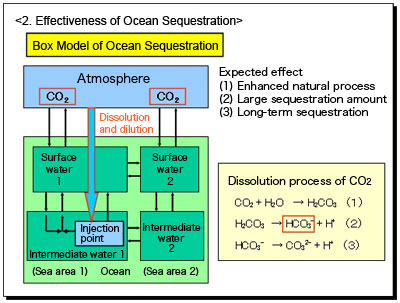
| Fig. 5 Ocean Carbon Cycle Model and Ocean Sequestration |
|
Ocean Carbon Cycle Model and Ocean Sequestration
Figure 5 shows a schematic model of the ocean CO2 sequestration method envisioned for our project.
In nature, atmospheric CO2 dissolves in the ocean surface water and diffuses vertically to the intermediate water depth and then horizontally to other sea areas, forming material cycles.
The Moving Ship Method ocean CO2 sequestration captures CO2 before it is released into the atmosphere, and injects it directly into the ocean at intermediate depth bypassing the surface water. The resultant effects include enhancement of the natural process, and sequestration of a large amount of CO2 since the technology utilizes the ocean at intermediate water depth accounting for about 95% of the entire ocean volume.
|
The CO2 sequestrated in the ocean is eventually
released back to the atmosphere. However, since vertical CO2
diffusion is very slow, at a 10 millionth to a 100 millionth the speed
of horizontal diffusion, long-term sequestration can be expected.
Moreover, since the discharge bypasses the surface water inhabited
by many marine organisms, this technology can be expected to have
a very low environmental impact. |
 |
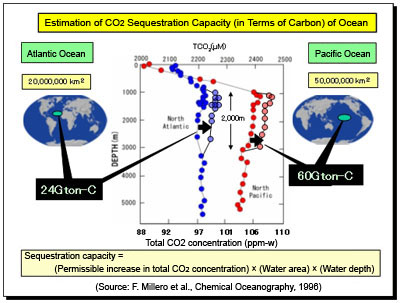
| Fig. 6 Estimation of CO2 Sequestration Capacity |
|
Estimation of CO2 Sequestration Capacity
The CO2 sequestration capacity of the oceans is estimated in the following. If the sequestration capacity is defined as the product of the permissible increase in total CO2 concentration, the water surface area, and the depth of water at which CO2 can be dissolved and diffused, the estimated sequestration capacities of the Atlantic Ocean and the Pacific Ocean are 24 GtC and 60 GtC, respectively.
Calculation of the sequestration capacity of the Atlantic Ocean used the assumption that the permissible increase in total CO2 concentration at a water depth of between 1,000 m and 3,000 m is 2% or approximately 50 micro-mol (approximately 2 ppm-w), based on the depth profile of CO2 as indicated by the blue dots in Figure 6. For both the Atlantic and Pacific Oceans, the calculation assumed that CO2 is sequestrated in the seawater at 2,000 m deep, in 50% of the water area having a depth of 4,000 m or more.
|
The total sequestration capacity thus calculated is 84 GtC, which
is considerably large compared with the annual increase in atmospheric
CO2 of 3.3 GtC. If the water area to be used
for sequestration and the permissible increase in total CO2
concentration are doubled, and the capacity of the Indian Ocean is
added, the CO2 sequestration capacity might
be increased to 508 GtC. |
|
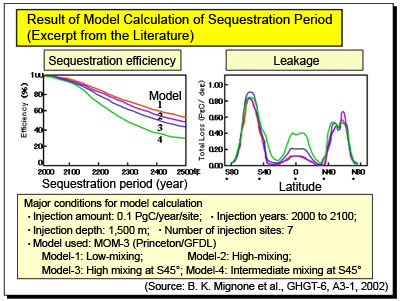
| Fig. 7 Estimation of CO2 Sequestration Period |
|
Estimation of CO2 Sequestration Period
The ocean sequestration period of CO2 dissolved and diluted in seawater was estimated by calculation. Figure 7 shows the result of the calculation. The calculation assumed that 0.1 GtC of CO2 is injected annually at a depth of 1,500 m at seven sites throughout the world, from year 2000 through 2100. Four models with different mixing conditions were used. The calculated sequestration efficiency at year 2200 is 60% at minimum and 85% at maximum. This calculation result shows that although part of the CO2 will be released back into the atmosphere, the majority of CO2 will remain sequestrated for several hundreds of years.
|
As shown in Figure 7, there is a tendency of higher CO2
release from the water areas at latitude 60。 south, latitude 60。 north,
and around the equator. Careful study is therefore necessary before
selecting CO2 injection sites. |
|
